The Ubiquity of AI Is Starting to Worry Me. What Happens When Creative Skill Is No Longer Scarce?

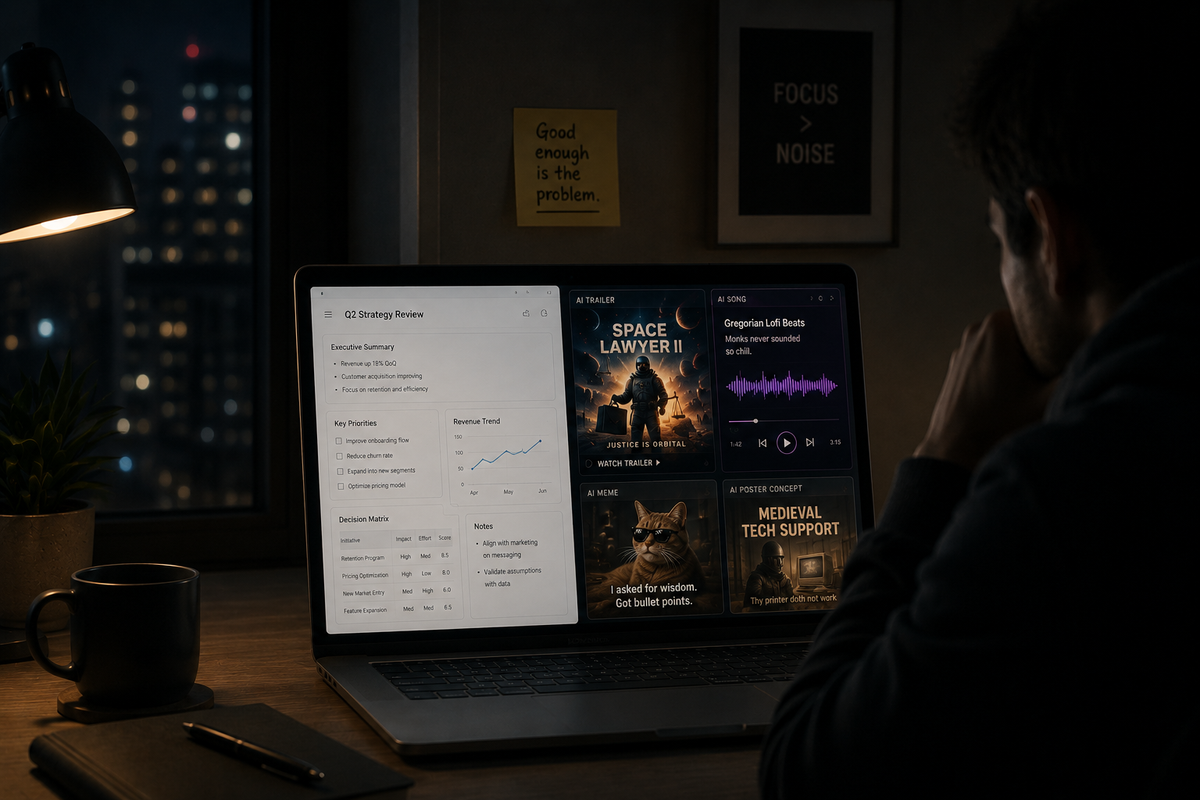
AI has quietly become a productivity multiplier in my life. Then I accidentally started making fake movie trailers, devotional remixes of raunchy Bollywood songs, and mildly concerning WhatsApp nonsense. That is when the questions started.
I should probably say this upfront:
I use it constantly, both at work and in everyday life, and not in the gimmicky “write me a polished email” sense.
In cybersecurity, it has quietly become an absurd productivity multiplier. I use it to accelerate research, pressure-test approaches, challenge assumptions, structure messy thinking, and generally reduce the amount of friction between idea and execution. But what has been more interesting is how quickly it has slipped into everything else.
I now use it to think through decisions, compare products, analyze health metrics, estimate calories and macros from meals, build what I jokingly call a health matrix for random food, troubleshoot annoyingly specific problems around TVs, toilets, HVAC, networking, and the dozens of small life-admin decisions that somehow consume disproportionate amounts of mental energy.
It has also become a surprisingly useful thinking partner. Not for outsourcing opinions, but for sharpening them. This applies to writing stuff too. Helping structure arguments, challenge weak reasoning, or acting as a sounding board when I am trying to think through something complicated.
The important qualifier here is domain knowledge. A random person with access to AI does not suddenly become an expert in cybersecurity, health, design, music, or finance. But someone who already understands the problem space suddenly becomes meaningfully faster and more effective. In the right hands, AI feels less like replacement and more like amplification, which is partly why what happened next started bothering me.
I Started Using AI for Needless Things
Like most people who spend too much time with a new technology, I eventually started using AI for completely unnecessary reasons.
It started innocently enough with WhatsApp nonsense, meme edits, face swaps with Bollywood celebrities and accompanying appropriate theme music, mildly controversial statuses, visual jokes, and the sort of things that exist purely to entertain me and mildly irritate friends and family for about 24 before disappearing into irrelevance. Some of these were apparently convincing enough to result in concerned friends reaching out to ask some variation of “What exactly is wrong with you?”, which, in hindsight, may have been fair feedback.
At the risk of revealing too much information on a public forum, what I was doing was essentially the sort of random nonsense one ends up doing while sitting in the bathroom, except instead of doomscrolling Instagram Reels like a normal person, I somehow convinced myself that generating increasingly unnecessary AI content was a more productive use of time. In fairness, part of me justified it as “prompt engineering practice,” which sounds significantly more respectable than admitting I was mostly seeing whether absurd ideas in my head could be made even remotely believable.
Nevertheless, somewhere along the way, I realized I could make movie posters. Not top-notch movie posters, obviously, but surprisingly convincing ones. Believable enough that if I dropped one into the right WhatsApp group, there is at least a reasonable chance somebody forwards it assuming the film actually exists. Naturally, this escalated into fake trailers and increasingly ridiculous movie concepts and mock-ups involving actors who had absolutely no business appearing together. Somewhere around this point, I had the slightly uncomfortable realization that what previously required a designer, an editor, and oodles of patience could now be approximated by me after dinner because I had an idea and apparently very few barriers between thought and execution.
Music, however, was where things got legitimately weird. At one point, after one particularly ridiculous idea, AI casually suggested turning it into a song, which is how I found myself creating a devotional reinterpretation of Choli Ke Peeche. Yes, that Choli Ke Peeche. The famously raunchy Bollywood song, except reimagined as a completely sincere bhajan sung in a male devotional voice, sounding disturbingly like something that could plausibly be playing near a temple at 6 AM.
And no, I am not going to post a link to the reimagined song here. A quick search for "Choli Ke Peeche Khalnayak English lyrics translation" should provide context, if needed.
The disturbing part was not that this capability existed but that it was weirdly coherent and connected. The output was not brilliant, obviously, but convincing enough that, not very long ago - producing something vaguely similar would have required musicians, recording software, production effort, and someone with at least a passing understanding of music.
I possess precisely zero of those qualifications.
Why This Feels Different
At this point, I started wondering whether I was simply overreacting because new technologies always feel magical at first. Photography was supposed to kill painting. Blogging lowered the barrier to publishing. Social media turned everybody into a content creator. Society adapts, new norms emerge, and the genuinely good stuff usually survives. But I do not think novelty alone explains why this has been bothering me.
What feels different is how little friction there suddenly is between idea and execution. Not very long ago, even stupid ideas had natural barriers to entry. Making a fake trailer would have required editing software, assets, music, technical skills, and enough motivation to see the whole thing through. Making music would have required musicians and recording tools. Even making a reasonably convincing meme, face swap, or visual joke would have required at least some combination of Photoshop skills, editing tools, or a willingness to spend far more effort than the joke deserved. Now I can have an absurd idea after dinner and, within 15 minutes, turn it into something vaguely believable. Not excellent by any means, but good enough that it would have required meaningful effort not very long ago. It comes down to this:
The closest analogy (although imperfect) I can think of is social media. Early Facebook felt meaningful. Then friction disappeared, engagement became the metric, and eventually the platform devolved into recycled opinions, outrage bait, questionable memes, and motivational quotes over sunsets from relatives who somehow became deeply philosophical after 2016. Essentially:
The democratization of any technology is not the problem. Frictionless amplification is. When the cost of creating and distributing content collapses, volume tends to win.
When “Good Enough” Becomes Infinite
There is an easy way to dismiss all of this: just call it AI slop. And to be fair, there is already an astonishing amount of genuinely terrible AI-generated content floating around the internet.
But I do not think that is the important part. AI slop is easy to identify because it is bad. What feels different, and mildly unsettling, is the growing category of AI-generated things that are not amazing but are coherent, culturally plausible, and good enough. Good enough that somebody forwards it assuming it is real, or that a devotional version of Choli Ke Peeche sounds strangely believable.
Case in point: This took minutes to create, was entirely fake, and would almost certainly convince quite a few people on the internet. (Brownie points for reading the last line in grey)

AI feels uncomfortably adjacent to that formula, except this time we are not talking just about status updates and random outrage bait. We are talking about songs, trailers, videos, and eventually entire forms of entertainment. Work that is good enough for most people not to care how it was made.
Once the output crosses the threshold from obviously bad to vaguely competent, the question stops being “Can AI create?” and becomes “What happens when competent creative output becomes abundant?”
Because this may ultimately be the uncomfortable implication - in a world where “reasonably good” becomes instant, cheap, and effectively infinite, there is increasingly less room for what we conventionally think of as mediocre.
I am not particularly worried about the really good creators. The best musicians, filmmakers, writers, and artists probably will survive because their value was never just execution. It was taste, judgment, originality, and emotional truth. What I wonder about is the massive middle tier. The competent-but-not-extraordinary work that sits between amateur and highly skilled/gifted. What happens when “good enough” becomes available to everyone for effectively zero cost?
The skill shifts from “Can you make something?” to “Can you decide what is worth making?”
The Cultural Implications
There is also a bigger cultural question buried in all of this. Historically, culture was shared. We watched the same films, listened to the same songs, waited for releases, and quoted the same scenes. I am not entirely sure that continues in a world of infinite personalised content.
If AI eventually gets good enough to generate entertainment tailored precisely to your humour, nostalgia, and worldview, do we slowly move from shared culture to personalized culture? Your version of media. My version of media. Perfectly optimized, endlessly abundant, and increasingly divergent from one another.
Delusional Confidence May Be the New Reality
The questions around “good enough” and the cultural implications are one side of this. The personal implications are the bit I find harder to ignore. After enough evenings making songs, posters, trailers, and entirely unnecessary WhatsApp nonsense, I briefly found myself wondering whether I am secretly more creative than I thought, which, in hindsight, may itself be part of the problem.
Maybe AI lets us temporarily rent capabilities we never actually earned.
The more uncomfortable part is that this delusional confidence likely extends well beyond creative work. Traditionally, expertise has revealed itself through outputs. A strong presentation, a thoughtful recommendation, good analysis, or sound judgement usually implied somebody knew what they were doing underneath. I am increasingly not sure that relationship remains quite as reliable anymore. That does not mean skill is disappearing. If anything, actual expertise probably becomes even more powerful when paired with AI. I see versions of this in my own work already. Somebody who understands the problem space becomes dramatically more effective.
At the same time, the line between actual competence and AI-assisted competence is getting blurry. Maybe the more significant shift is that we gradually get worse at telling the difference. Maybe people in the future will not suddenly be more creative, insightful, or capable than before. Maybe people will have simply rented access to capabilities that previously sat behind years of training and technical skill.
There is a very real possibility that this entire blog post (including the cover image) is itself an example of the problem I'm describing. Personally, I think it is reasonably thoughtful and well argued. Having said that, I cannot discount the fact that I have simply become articulate with AI-based "rented" intelligence and am now too close to the process to truly tell the difference.
I will leave whoever reads this to decide which side of that coin this lands on (if you made it this far through the post, that is).
For now, I take some comfort in the fact that I have not yet crossed the line into posting vaguely inspirational, AI-generated, corporate-themed, pseudo- motivation content on LinkedIn, inevitably accompanied by some arbitrarily unrelated lesson about leadership.